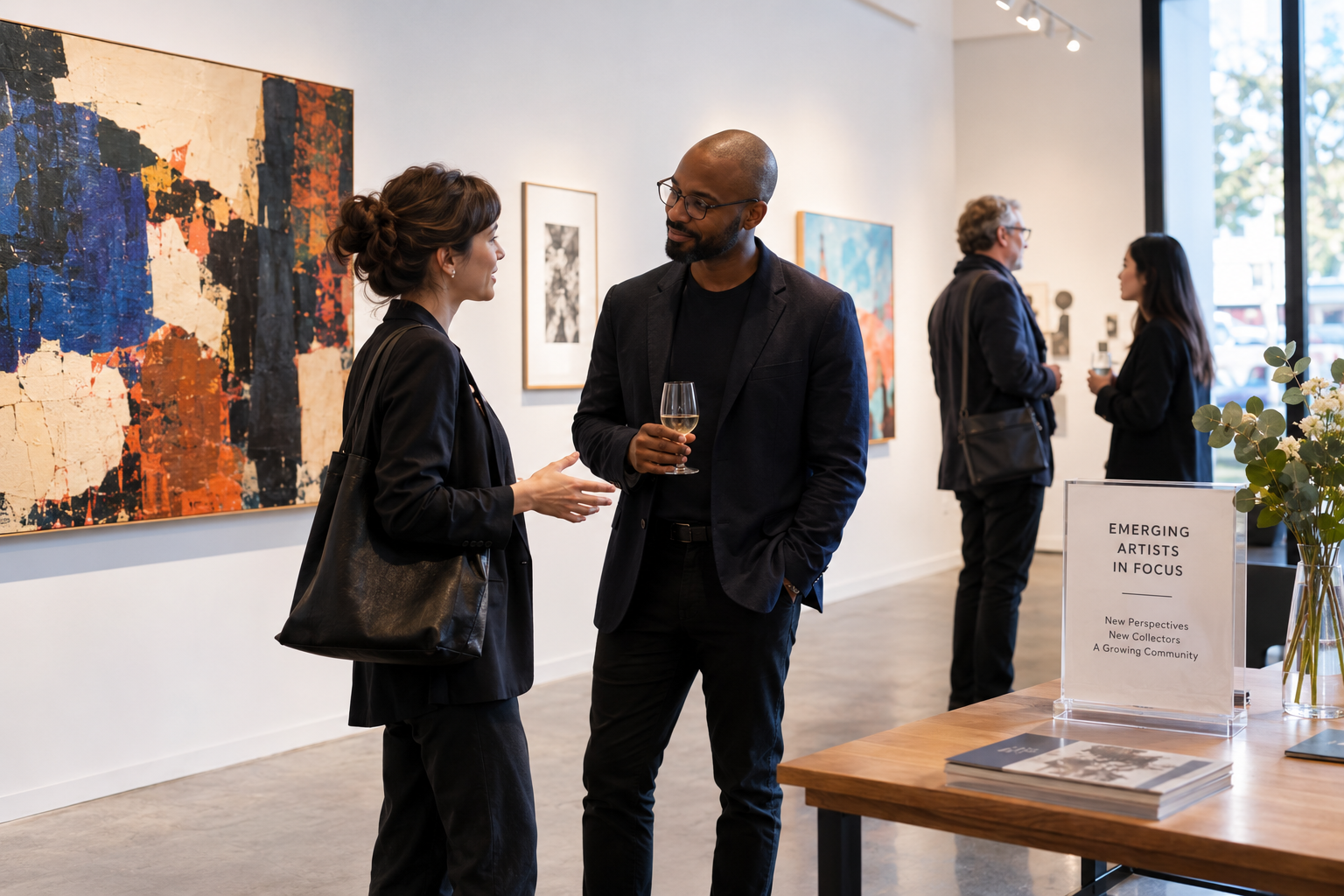
Image source: AI-generated by ChatGPT (DALL-E 3), OpenAI, October 22, 2026.
You have made the work. Now how do you find the people who might want to live with it?
Building your collector base when you’re an artist who posts a new work online is not as easy as it may seem. A few people like the image, someone comments that it is beautiful, and the post disappears into the feed. You again a week later. The same thing happens.
The problem may not be a lack of talent or even a lack of interest. As an artist you’re treating each post as an isolated attempt to sell, rather than building a relationship with people who have a reason to follow the work over time.
A collector base is not simply a list of people who have purchased something. It is a network of people who are interested in the artist’s work, understand something about the practice, and have a way to remain connected. Some will eventually buy. Others may introduce the artist to someone else, visit an exhibition, commission a work, or follow the development of a series for years.
There is no guaranteed path from an online follower to a collector. But there are practical ways to make that path easier to follow.
Key Takeaways
- You do not need a large audience to begin building meaningful collector relationships.
- Potential collectors are more likely to engage when they can understand the work, the artist’s practice, and how to ask questions or purchase.
- Research shows that collectors use a mixture of gallery, fair, online, and direct artist channels.
- The quality of relationships matters more than the raw number of contacts.
- A collector base grows through repeated, useful interactions not through constant sales pitches.
First, understand who might collect your work
“Find collectors” sounds like a single task, but it actually contains several different questions. Who is likely to respond to the work? Where do those people encounter art? What information do they need before buying? What kind of relationship would feel natural to them?
The answers vary. Someone who collects contemporary photography may discover artists through galleries, publications, fairs, or online platforms. A buyer interested in local artists may respond to studio visits, community exhibitions, or recommendations. A person drawn to a particular subject or visual language may begin following an artist long before they have the space or budget to purchase.
Do not assume that the best audience is simply the wealthiest audience. A potential collector needs some combination of interest, access, trust, and purchasing capacity. A high-income person who has no connection to the work may be less relevant than someone who has followed the artist’s development and regularly engages with the practice.
Start by examining your existing audience. Who asks thoughtful questions? Who returns to see new work? Who shares exhibitions or sends your work to others? Who has bought a print, attended an event, or asked about a commission? These behaviors can help you identify where a meaningful relationship may already be forming.
What the research says about how collectors buy
The Art Basel and UBS Survey of Global Collecting 2026, authored by Arts Economics, found that 69% of the surveyed high-net-worth collectors had purchased directly from artists in 2025 or the first half of 2026. This included studio purchases, commissions, and purchases through Instagram. Dealers remained important too: 87% of respondents had purchased through a dealer in some form. Because collectors use multiple channels, these figures are not mutually exclusive. [1]
The significance is not that every artist should sell directly or that galleries are becoming irrelevant. It is that collectors can discover and purchase through several routes. An artist can build relationships online, meet people through exhibitions, receive introductions from existing buyers, and work with galleries where appropriate.
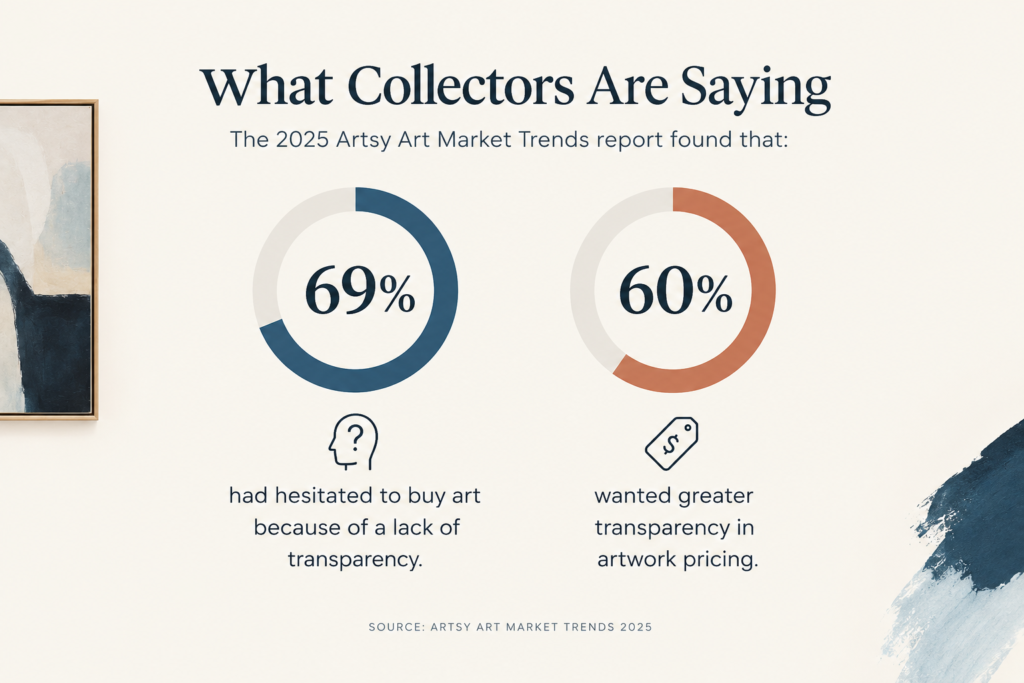
The 2025 Artsy Art Market Trends report adds another important point. Among its surveyed collectors, 69% said they had hesitated to buy art because of a lack of transparency, and 60% wanted greater transparency in artwork pricing. [2] Interest does not always turn into a purchase when practical information is missing.
Image source: AI-generated by ChatGPT (DALL-E 3), OpenAI, October 22, 2026.
For artists, this means collector development is partly about access. Make it easy for an interested person to understand the work, learn about the artist, find information about a specific piece, and take the next step.
Create a clear place for the relationship to continue
Social media can introduce people to the work, but the artist should not rely on one platform as the entire relationship. Feeds change, posts lose visibility, and casual attention can disappear quickly.
A professional website or portfolio gives interested people a stable place to find the artist’s biography, selected work, exhibitions, artwork details, and contact information. A mailing list allows the artist to communicate with people who have chosen to hear from them. A well-maintained contact record helps the artist remember where a conversation began and what the person actually expressed interest in.
These tools do not have to be complicated. They need to be accurate and useful.
For each artwork, provide a clear title, image, medium, dimensions, year, and availability. Where appropriate, include edition information, framing details, and a price or straightforward inquiry process. If the work is unavailable, say so. Do not leave people guessing whether they are allowed to ask about it.
The purpose is not to make every visitor buy immediately. It is to make a genuine interest easier to pursue.
Give people a reason to follow the work
A collector relationship becomes more meaningful when communication offers something beyond repeated announcements that new art is for sale.
Share the development of a series, explain a material decision, show how a work changes in different lighting, discuss an exhibition that shaped the practice, or introduce a question you are exploring. The aim is not to reveal every private detail of the creative process. It is to give interested viewers a clearer understanding of what they are seeing and why the work is developing.
A useful test is whether a message would still have value to someone who is not ready to purchase today. If the only reason to communicate is to ask for a sale, the relationship may feel transactional. If every message provides context but never explains how to buy, the artist may be making the opposite mistake.
The balance is to build interest and make the commercial path visible without forcing the decision.
Turn attention into a real conversation
When someone comments thoughtfully on a work, asks about a series, or attends an exhibition, respond to the actual interaction. Ask a relevant question if it feels natural. Offer more information if requested. If someone wants to see the work in person, explain how that can happen.
Do not assume that every interaction is a sales lead. A person may be an artist, student, curator, writer, or simply someone who appreciates the work. Treating every contact as a prospect can make communication feel impersonal and undermine trust.
When a person does express buying interest, make the next step clear. Answer questions about price, dimensions, shipping, payment, and availability. If a work is outside their budget, you can explain whether there are other available works or editions, provided that is accurate and relevant. Avoid using pressure, false scarcity, or promises of future appreciation to force a decision.
Collectors should be able to decide without feeling manipulated.
The first sale is not the end of the relationship
A first purchase creates a practical opportunity to build trust. Deliver the work as agreed, provide any relevant documentation, communicate about shipping or collection, and keep accurate records. If there is a delay or problem, address it directly.
After the sale, follow up appropriately. Thank the buyer, confirm that the work arrived safely, and remain available for questions. Do not immediately turn the purchase into a demand for referrals or another sale.
Over time, you can share relevant developments with people who have indicated they want to hear from you. A collector who bought a small work may be interested in a new series. Someone who commissioned a piece may value updates about its installation. Another buyer may simply want to attend exhibitions.
There is no need to treat every buyer identically. Remembering a person’s interests and communicating with permission helps make the relationship more personal and less like a mass marketing campaign.
A simple 90-day plan
Days 1–30: Build the foundation. Review your website and portfolio. Ensure artwork details are accurate, prices or inquiry routes are clear, and the contact process works. Create a simple record of existing inquiries, buyers, exhibition contacts, and people who have asked to receive updates.
Days 31–60: Research and connect. Identify a small number of relevant galleries, exhibitions, collector communities, and local or online opportunities. Engage with the work and programs of people or organizations that genuinely fit your practice. Share selected work with context instead of sending generic pitches to everyone.
Days 61–90: Establish a rhythm. Send a useful update to people who have opted in. Share a new work or development with enough information to understand it. Follow up on active conversations, record questions that recur, and review which channels lead to meaningful engagement.
At the end of the period, assess what happened. Did people inquire about work? Did anyone return to the site or exhibition? Did you receive questions that revealed a need for better information? Did a conversation lead to a studio visit, a referral, or a sale? Use the evidence to adjust the next three months.
This plan cannot guarantee a collector or a sale in 90 days. Its purpose is to establish a repeatable process that gives relationships a chance to develop.
Signals of progress and what they do not prove
A growing email list can be useful, but it does not prove that people will buy. A collector asking detailed questions is a stronger sign of interest, but it is not a guarantee of a purchase. A first sale shows that a particular transaction worked; it does not establish that every future work will sell at the same price.
Look for patterns rather than predictions. Are the people engaging with your work becoming more relevant to your goals? Are inquiries more informed? Are previous buyers returning? Are your relationships leading to introductions, visits, commissions, or repeat purchases? Are people understanding the practice more clearly?
For a deeper look at how collectors discover artists before broader recognition, read How to Discover Emerging Artists Before the Crowd. The article complements this one by examining how collectors evaluate artists and the signals they use to decide which work deserves closer attention.
Frequently Asked Questions
How many collectors do I need to build a sustainable art career?
There is no universal number. The answer depends on the price of your work, production capacity, sales frequency, expenses, and the mix of income supporting the practice. A small group of repeat buyers may be valuable, but it still needs to be assessed against the artist’s actual financial needs.
Should I offer discounts to attract first-time buyers?
Discounts are not the only way to reduce barriers. Clear information, accessible formats, transparent terms, and opportunities to see the work in person may be more appropriate. If you do offer a discount, understand its effect on net revenue and keep it consistent with any gallery or sales agreements.
Is Instagram enough to build a collector base?
Instagram can be useful for discovery and direct sales, but relying on a single platform creates risks. A website, contact list, exhibitions, referrals, or other channels can help preserve relationships and give collectors more ways to understand the work.
How often should artists contact collectors?
There is no fixed frequency that suits every practice. Communicate when you have something relevant to share, respect people’s preferences, and avoid sending repeated sales messages to people who have not shown interest. A consistent and useful rhythm is more important than constant contact.
Conclusion: Build relationships that can outlast a single sale
A collector base is not created by convincing strangers to buy as quickly as possible. It develops when people can discover the work, understand the practice, trust the artist, and remain connected in a way that feels worthwhile.
The process requires both artistic clarity and professional reliability. Present the work well. Make practical information accessible. Respond thoughtfully. Deliver what you promise. Give people reasons to keep following the practice, and make it easy for those who are ready to buy to take the next step.
You cannot control when a person becomes a collector. You can build the conditions that make a relationship possible—and improve those conditions as you learn from the people who respond.
Sources
[1] Art Basel and UBS. The Art Basel & UBS Survey of Global Collecting 2026, authored by Arts Economics. Sales channels section. https://theartmarket.artbasel.com/channels
[2] Kakar, Arun. “Art Market Trends 2025.” Artsy, published April 24, 2025; updated June 27, 2025. https://www.artsy.net/article/artsy-editorial-art-market-trends-2025