

How Surrealism and abstraction expanded the language of modern art, and how Masha Schwartz’s Surreabstract Art explores what happens when the two coexist.
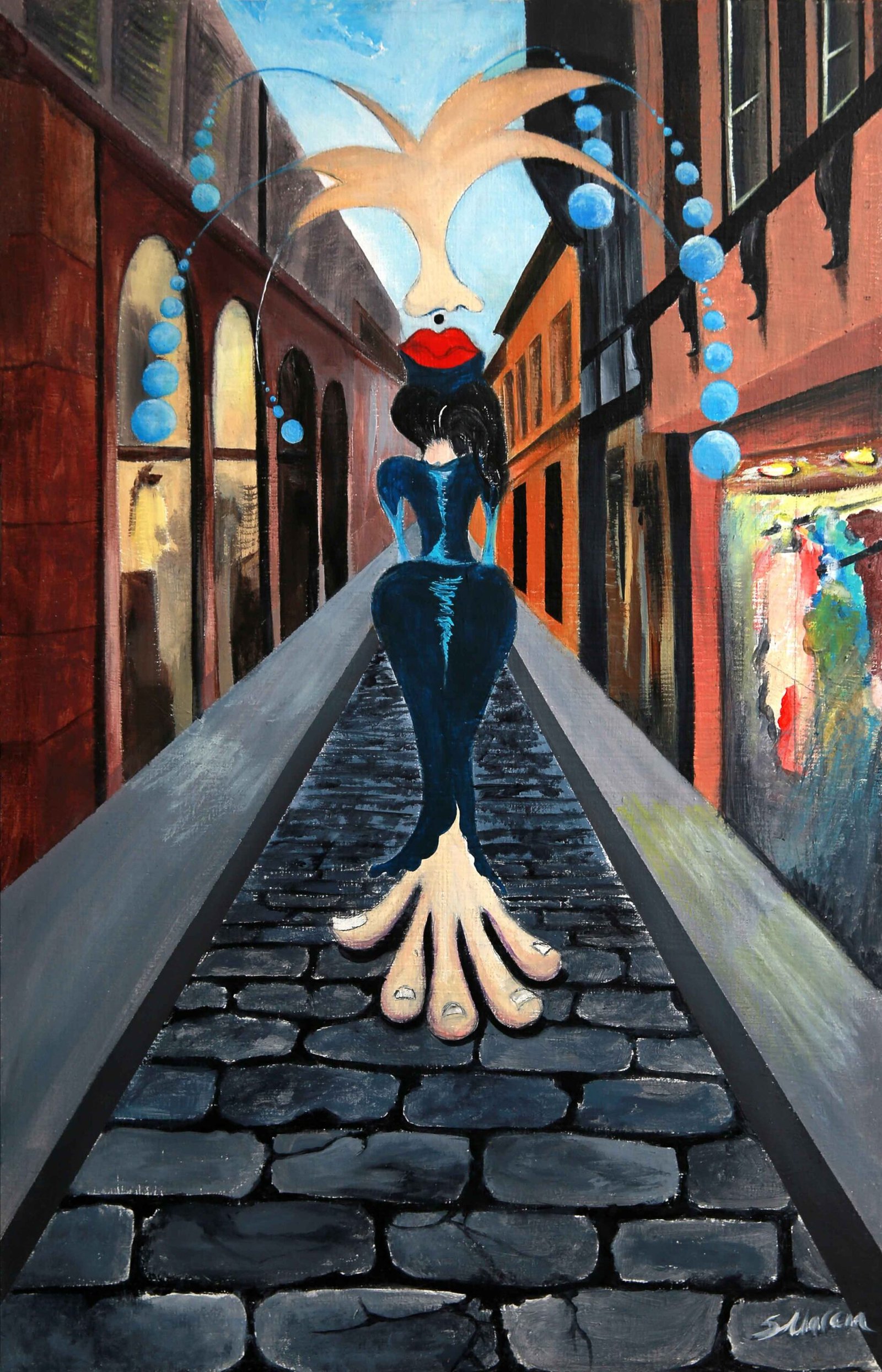
Masha Schwartz
Lady Walking in Old City, 2005
Masha Schwartz Art
Source: https://www.artworkarchive.com/profile/masha-schwartz-art/artwork/lady-walking-in-the-old-city
Key Takeaways
- Surrealism challenged the limits of rational, waking perception through dreams, spontaneous methods, and unexpected associations. [1] It opened the door to dreams, subconscious associations, unexpected combinations, and irrational imagery, while abstraction increasingly liberated color, line, shape, and composition from the obligation to represent recognizable objects.
- Abstraction expanded the role of color, line, shape, and composition beyond literal representation.
- Artists such as André Masson demonstrated how recognizable imagery can emerge from abstract marks rather than being fully planned in advance. [2]
- Masha Schwartz’s Surreabstract Art explores the coexistence of recognizable imagery and abstract visual elements.
- Artists can use this intersection to develop ideas that begin as sensations, fragments, or partially formed images, then refine them through deliberate composition.
- Collectors can look beyond a first impression by studying an artist’s visual language, body of work, provenance, and documented details.
- Historical connections provide context, but the quality and individuality of a contemporary work must be assessed on its own terms.
When Surrealism Meets Abstraction, Something Unexpected Happens
Surrealism and abstraction challenged two different assumptions about art. Surrealists asked whether a painting could reveal a reality beyond ordinary perception, drawing on dreams, unexpected associations, and the workings of the subconscious. Abstract artists questioned whether art needed to represent recognizable objects at all. One opened the door to the impossible; the other loosened the image’s obligation to describe the visible world.
Yet these territories were never completely separate. A line that begins without a predetermined subject can gradually suggest a body, an animal, or an unfamiliar landscape. A recognizable form can dissolve into color and movement without losing every trace of its identity. The result is an image that does not settle into a single interpretation.
Artists including Joan Miró, André Masson, and Max Ernst explored different aspects of this territory. Their experiments helped establish that an artwork could emerge from spontaneous marks, dreamlike associations, and forms that move between recognition and abstraction. [1][2] Masha Schwartz explores this intersection through Surreabstract Art, developing compositions in which recognizable imagery and abstract visual elements coexist. Her work invites viewers to consider not only what an image depicts, but also what becomes possible when its forms resist a single, fixed reading.
For artists, understanding this artistic lineage opens questions about how images develop and how much control a composition needs. For collectors, it provides a richer way to examine an artist’s visual language, creative decisions, and individual contribution.
Surrealism: Looking Beyond the Visible World
When André Breton published the Surrealist Manifesto in 1924, he described a movement seeking to move beyond the constraints of rational thought. Influenced by psychoanalytic ideas associated with Sigmund Freud, Surrealists explored dreams, involuntary associations, and forms of expression that appeared before conscious reasoning could fully organize them. Their methods included automatic drawing, unexpected combinations of objects, and meticulously rendered scenes that made impossible situations seem strangely convincing. [1]
Surrealism was never simply a matter of painting unusual things. Its deeper ambition was to challenge the assumption that ordinary waking logic represented the full range of human experience. An image could connect objects that had no practical relationship, distort a familiar body, or place a recognizable subject in an impossible setting. These choices unsettled the viewer’s confidence in what was real, what was imagined, and what the mind might produce beyond deliberate control.
André Masson’s Automatic Drawing (1924) provides a particularly useful example. Masson began without a predetermined subject, allowing his pen to move rapidly across the paper. Within the resulting web of lines, fragments of bodies and objects began to emerge. He sometimes developed those suggestions further, but much of the spontaneous drawing remained visible. [2]
The significance lies in the relationship between chance and recognition. The marks are not simply random decoration, nor are they entirely dictated by a finished image imagined in advance. The viewer encounters a form in the process of becoming recognizable. The drawing occupies a space between abstraction and representation, demonstrating how a visual idea can emerge through the act of making rather than through a fully specified plan.
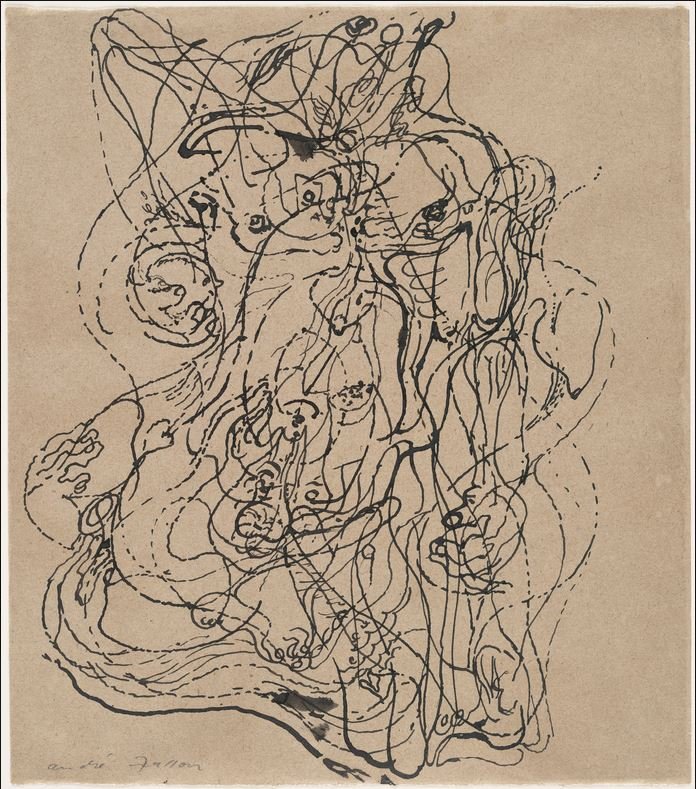
André Masson,
Automatic Drawing (1924)
Museum of Modern Art
Source: https://www.moma.org/collection/works/38201
Abstraction: When Representation Is No Longer the Only Goal
Abstraction introduced a different but equally consequential question: must a painting describe something recognizable in the external world to communicate meaning?
As artists experimented with color, line, rhythm, shape, and composition, these elements increasingly became subjects in their own right. A painting could create tension through opposing forms, suggest movement through directional lines, or establish an emotional atmosphere through color relationships without depicting a literal scene.
This did not mean that abstraction had to be empty of reference or feeling. A nonrepresentational composition can suggest energy, conflict, balance, expansion, or compression. Viewers may respond to those qualities before identifying any subject. Other works retain fragments of recognizable forms, allowing representation and abstraction to interact rather than forcing a choice between them.
Joan Miró’s experiments illustrate how a visual language can move between recognizable signs and forms that resist straightforward identification. His work draws on a vocabulary of shapes, lines, and suggestive symbols without depending on conventional naturalistic representation. Max Ernst’s experiments, meanwhile, demonstrate how unfamiliar images and unexpected visual relationships can emerge through inventive processes and material exploration. [3][4]
These artists should not be treated as though they were all pursuing the same objective. Their approaches differed, as did their ideas about what images could accomplish. What connects them is a willingness to move beyond the assumption that a painting’s meaning must be delivered through literal depiction.
For contemporary artists, that history creates room to ask a more precise question: what happens when recognizable imagery is not removed, but placed in active conversation with abstraction?
The Space Between Recognition and Possibility
The most compelling images do not always reveal everything immediately. A viewer may recognize one form, notice another, and then reconsider the relationship between them. Color may strengthen a first impression or undermine it. A line may appear to define a figure while also functioning as an independent abstract element. What first seemed incidental can become central to the image.
This ambiguity is not automatically a sign of depth. Confusion alone does not make a work meaningful, and abstraction does not excuse a composition from visual discipline. The more interesting question is whether the uncertainty has been constructed with intention: whether the relationships among form, color, movement, and recognizable imagery give the viewer something worth discovering.
That distinction matters to both making and collecting art. For artists, the challenge is to create a composition that remains visually coherent even when its meaning is not singular. For collectors, the challenge is to look beyond the first recognizable subject and consider how the artist has built the experience of looking.
A work may reward repeated viewing because the relationships within it change in importance as the viewer becomes more familiar with the composition. The image itself has not changed, but the viewer’s attention has. A detail that initially appeared secondary may reveal a connection that reorganizes the whole.
This is one reason that art cannot always be evaluated through a quick glance or a short caption. The first impression is only an entry point. Looking carefully means noticing how the work directs attention, creates visual tension, and allows different elements to support or complicate one another.
Masha Schwartz and the Surreabstract Approach
Masha Schwartz’s Surreabstract Art brings the intersection of Surrealism and abstraction into a contemporary visual practice. Rather than treating recognizable imagery and abstract composition as mutually exclusive choices, her work explores how they can coexist within a single image.
The value of this approach is not simply that a viewer may see more than one thing. Multiple interpretations are possible in many forms of art. The more useful question is how the image organizes those possibilities: how its forms relate, how its colors direct attention, and how the balance between recognition and abstraction shapes the viewing experience.
For artists, this offers a way to reconsider the early stages of an idea. A visual concept does not always arrive as a complete subject with a clear outline and predetermined composition. Sometimes the idea begins with a sensation, a color relationship, a fragment of an image, or a mark whose meaning becomes clearer only as the work develops. The artist’s task is to discover which elements deserve to remain, which need to change, and how the developing composition can preserve its energy while becoming more intentional.
For collectors, a useful starting point is to examine the artist’s decisions rather than trying to solve the image as if it were a puzzle with one correct answer. What attracts the eye first? Where does the composition become less predictable? Do the abstract elements reinforce the recognizable forms, disrupt them, or create a second visual reading? Does the work continue to offer new relationships after the first impression has passed?
These questions do not require a specialist vocabulary. They require sustained attention and a willingness to let the work be more complex than its initial description.
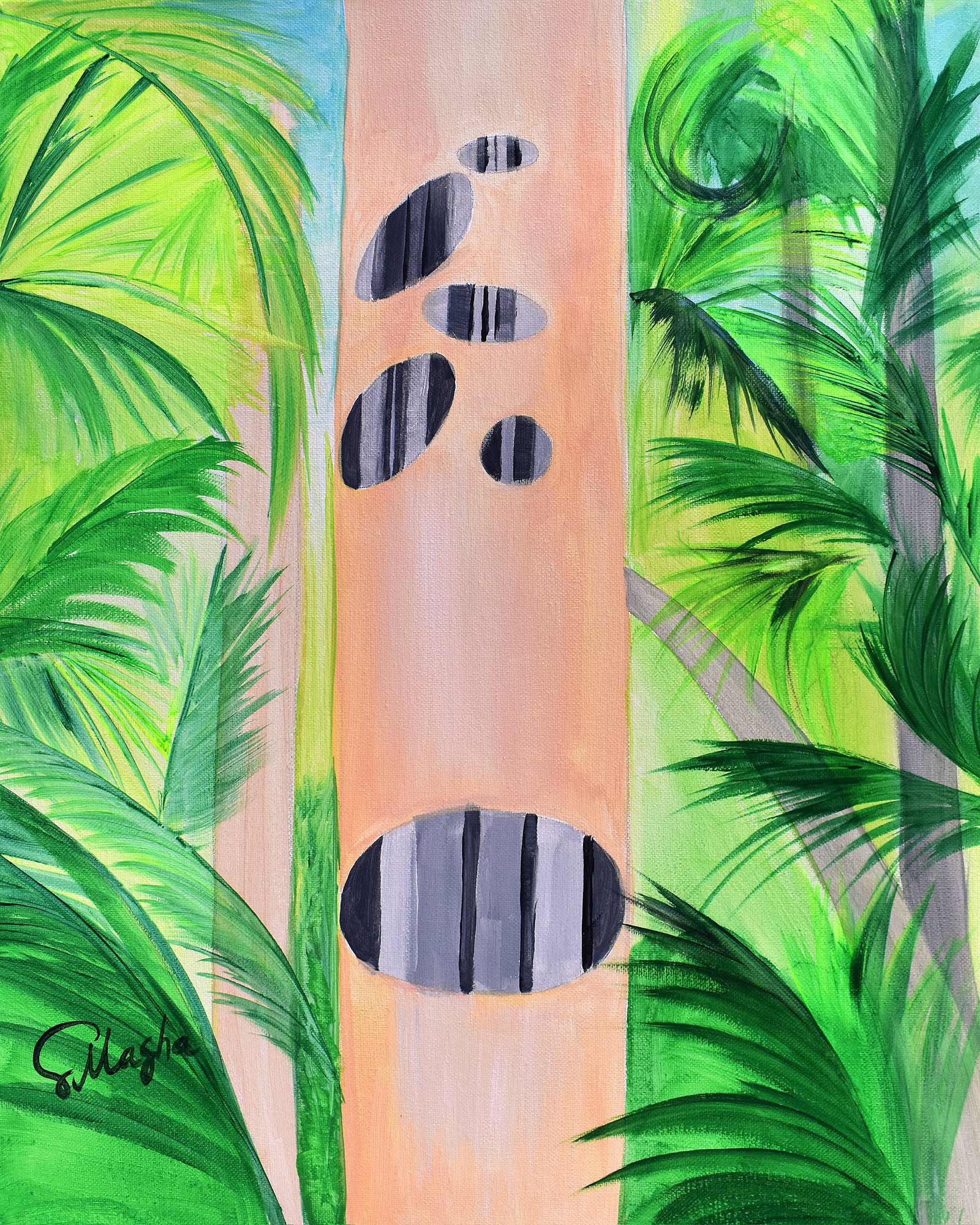
Masha Schwartz
Enjoying the Sun
Masha Schwartz Art
Buy Original – $9,600 USD | Other Artworks by this Artist
Masha evokes a moment of pure relaxation in Enjoying the Sun. A woman leans back against a sunlit column, her form bathed in warmth as scattered ovals map the points where her body meets stone. Framed by lush green foliage, the composition captures the serene balance between human presence and natural light, transforming heat into a visual embrace.
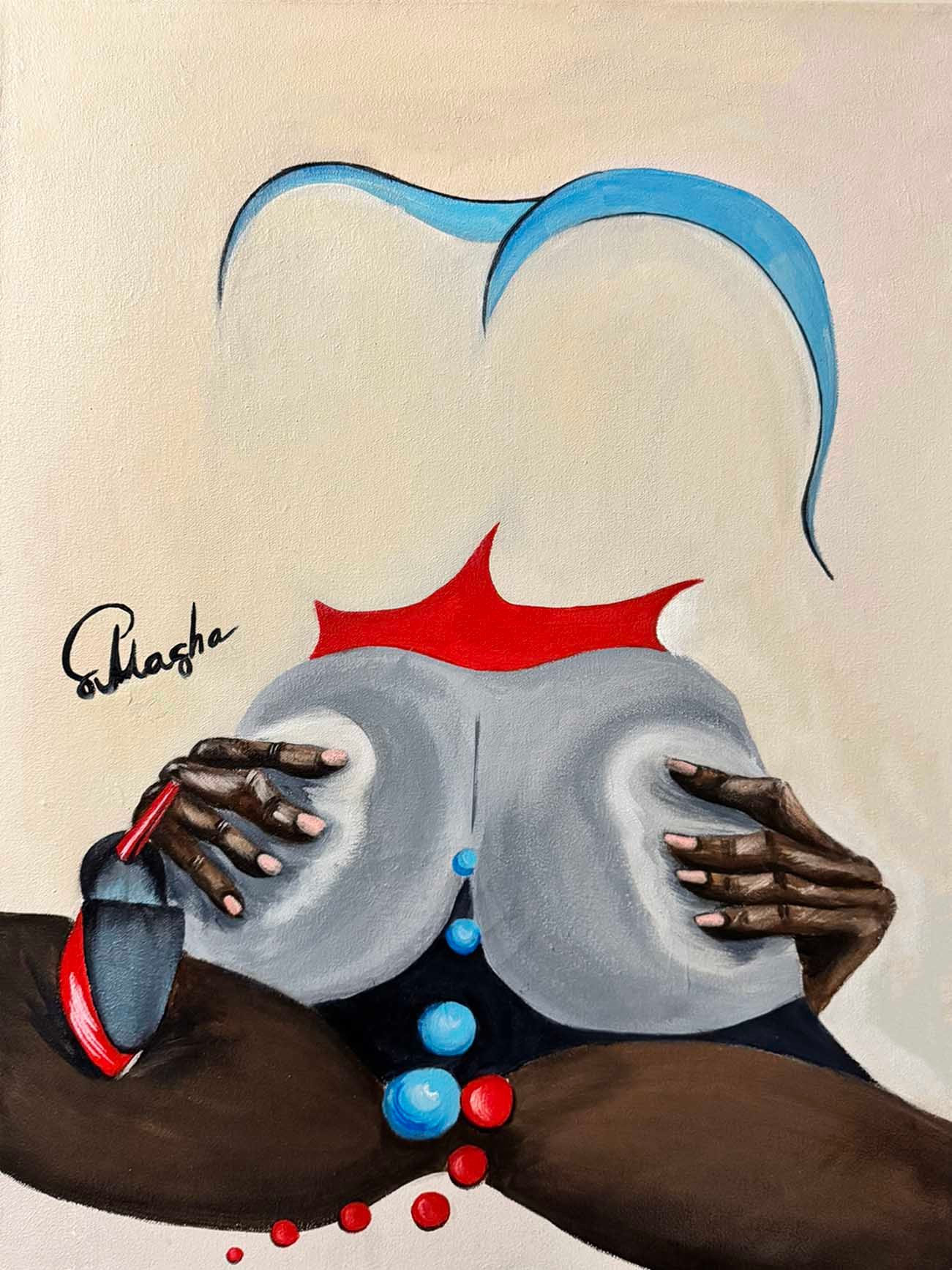
Masha Schwartz
Lunch Break
Masha Schwartz Art
Buy Original – $17,280 USD | Other Artworks by this Artist
In Lunch Break, the act of desire becomes a metaphor for hunger far beyond the physical. A faceless figure, stylized in soft grays and accentuated by vivid red and blue accents, reclines confidently. Her hips are framed by large, expressive hands mid-grip, strong, focused, unapologetic. The pearls or droplets spilling below suggest indulgence, urgency, or ideas too ripe to hold back.
The scene is layered in contrast. The smooth curves and stark background feel minimalist, yet the gesture and color imply something complex beneath the surface. There is power in the way she holds her own form, as if taking a moment to honor herself in the middle of life’s demands.
Lunch Break challenges traditional notions of rest and productivity. It implies that in the pursuit of success, whether artistic, entrepreneurial, or sensual, we must also embrace moments of raw presence. This is not about escape. It’s about return. Return to the body, to instinct, and to the intimate kind of nourishment that fuels bold ideas.
What Collectors Can Learn From This Intersection
Art history can help collectors recognize the questions an artist is exploring, but historical association alone does not establish an artwork’s quality or significance. A contemporary artist does not become important simply by sharing a technique or visual interest with a celebrated predecessor. The more productive approach is to understand the historical conversation, then evaluate what the artist contributes to it.
Consider three areas when looking at a work that combines surreal or dreamlike imagery with abstraction.
First, examine the visual language. Are the forms, colors, and compositional relationships distinctive? Does the artist make consistent choices that can be recognized across different works without making every piece feel interchangeable?
Second, consider how the work develops meaning. Does the image sustain attention beyond its initial effect? Are there relationships between elements that become more apparent with time? Does the work invite interpretation while remaining visually coherent?
Third, learn about the artist’s practice. Look at a body of work rather than judging a single image in isolation. Read the artist’s statements, explore the development of recurring themes, and seek reliable information about materials, provenance, exhibition history, and availability when considering a purchase.
The contemporary art market also gives collectors multiple ways to discover and purchase emerging artist works. In its August 2026 discussion of collector experiences, Art Basel reported that artist-direct purchases, including studio sales, commissions, and purchases through digital channels, had become a substantial part of surveyed collectors’ spending. [5] This makes it increasingly useful for collectors to learn how to evaluate work and research artists independently, whether they ultimately buy directly or through a gallery.
Direct access does not remove the need for due diligence. Collectors should confirm the artwork’s title, medium, dimensions, condition, provenance where applicable, shipping arrangements, and certificate of authenticity when one is provided. They should also clarify whether a displayed image represents an original, a limited edition, or a reproduction.
How Artists Can Work Between the Two
Artists interested in the relationship between Surrealism and abstraction as they explore deeper the art of making two realities exist at once do not need to imitate historical techniques. They can begin by observing how their own ideas move between a recognizable subject and a less defined visual impulse.
One exercise is to begin with a form that has personal significance, then loosen the expectation that it must remain literal. Explore changes in scale, color, orientation, and surrounding shapes. Notice which alterations strengthen the composition and which make it less coherent. The objective is not to make the image obscure; it is to discover whether a more complex visual relationship is possible.
A second exercise is to work from marks before deciding what they represent. Allow lines or shapes to emerge without immediately assigning them a subject. Afterward, look for forms that appear naturally and decide whether developing them would strengthen the work. Masson’s automatic drawing offers a historical example of this movement from spontaneous marks toward emerging imagery, although every contemporary artist must determine their own process. [2]
A third exercise is to return to the work after a break. Distance can help distinguish an exciting initial idea from a visual decision that genuinely serves the composition. Ask whether each element contributes to the whole, whether the work needs greater clarity or greater openness, and whether the final balance feels intentional.
The process requires both receptivity and judgment. Too much control can close down a promising idea before it has developed. Too little editing can leave a work without the structure needed to sustain attention. The challenge is to recognize when an emerging possibility should be followed and when the composition needs a more deliberate decision.
For a deeper look at the creative process behind this approach, continue with Surreabstract Creativity: How to Create What You Cannot Yet Explain.
Sources
[1] Museum of Modern Art (MoMA). “Surrealism.”
MoMA’s overview of Surrealism, its historical development, relationship to the subconscious, dreams, automatism, and visual experimentation.
[2] Museum of Modern Art (MoMA). “Surrealist Strategies.”
Overview of automatic drawing, experimental methods, found objects, and other Surrealist approaches.
Read MoMA’s Surrealist Strategies overview
[3] Museum of Modern Art (MoMA). “Surrealism and Dreams.”
Research on Surrealism’s relationship with dreams, the subconscious, automatic processes, and free association.
Read MoMA’s Surrealism and Dreams overview
[4] Museum of Modern Art (MoMA). “Wassily Kandinsky.”
Background on Kandinsky’s development of abstraction and his theories concerning color, form, and emotional expression.
Read MoMA’s Kandinsky research
[5] Museum of Modern Art (MoMA). “Joan Miró.”
Research describing Miró’s combination of the real and imaginary, abstraction and figuration, and his relationship to Surrealism.
Read MoMA’s Joan Miró research
[6] Museum of Modern Art. “Surrealist Prints: An Overview.”
Historical overview documenting the diversity of approaches within Surrealism, including abstract automatist and illusionistic approaches.
Read the MoMA Surrealist Prints research